How We’re Advancing Sustainable Conveyor Belt Materials with Recovered Carbon Black
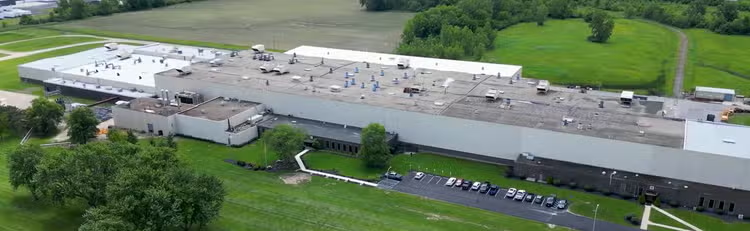
One of the biggest opportunities to reduce environmental impact in rubber manufacturing lies in raw materials. In our North American plants, Continental is helping to address this challenge by beginning to integrate Recovered Carbon Black (rCB) into select conveying solutions compounds.
Carbon black is a critical ingredient in conveyor belt compounds, helping contribute to the product’s strength, durability, and wear resistance. By replacing a portion of conventional virgin carbon black with recovered material, we’re taking a tangible step toward circular material use—turning waste into a valuable resource.
Typically, virgin carbon black is produced from fossil fuels. On the other hand, rCB, from our partner Bolder Industries, is made from end‑of‑life and post‑consumer or post‑industrial rubber—including discarded tires. Through a specialized thermal pyrolysis process that operates without oxygen, rubber waste is converted into reusable materials, including high‑quality recovered carbon black.
This approach directly supports circularity by:
- Diverting rubber waste from landfills
- Reducing dependence on fossil‑based raw materials
- Lowering the environmental footprint of rubber products
Sustainable Materials at a Glance
Recovered Carbon Black (rCB) offers compelling environmental advantages:
- Produced from 100% post‑consumer or post‑industrial rubber waste
- Manufactured using thermal pyrolysis, processing rubber without oxygen
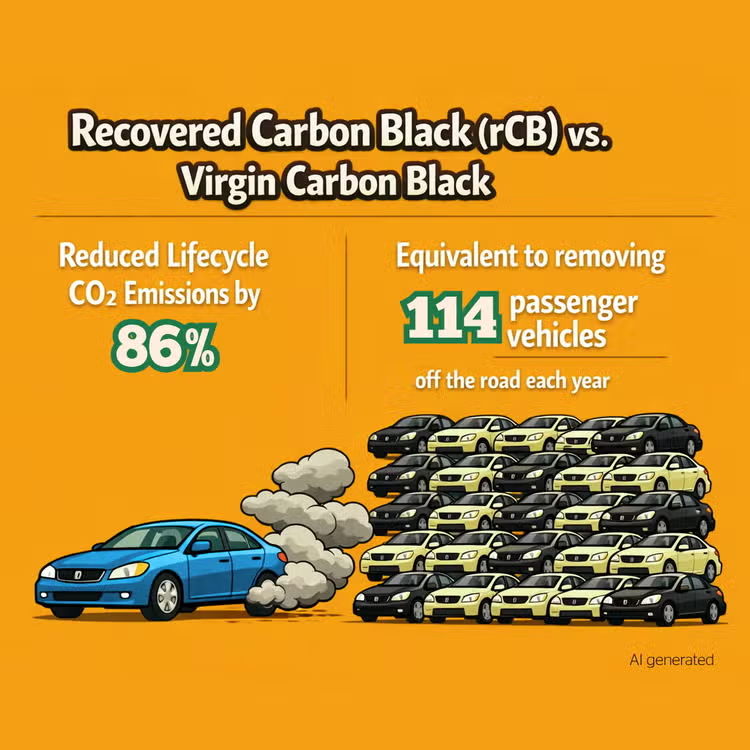
- Delivers approximately an 86% reduction in greenhouse gas emissions compared to conventional virgin carbon black production*
- Uses roughly 98% less water than traditional methods*
- Helps keep end‑of‑life tires out of landfills while displacing fossil‑based inputs
*Based on data provided by Bolder Industries.
What This Means in Practical Terms
For business leaders, this means sustainability gains that are not theoretical—they are measurable, scalable, and achievable today.
Our adoption of rCB in North America is already happening on a meaningful scale: approximately 157,000 lbs. of rCB was used over the past 12 months. At this volume, replacing virgin carbon black with rCB avoids an estimated 487 metric tons of CO₂e.
To put that impact into everyday context, this reduction is roughly equivalent to:
- Removing about 114 passenger vehicles from the road for a year
- Avoiding approximately 1,240,175 miles driven by an average gasoline‑powered car
- Offsetting the annual electricity use of around 102 U.S. homes
These estimates are conservative, order of magnitude equivalents designed to clearly communicate real environmental benefits using widely accepted lifecycle emission factors. Green Gas Equivalencies are based on US EPA calculator.
Implementation Across North America
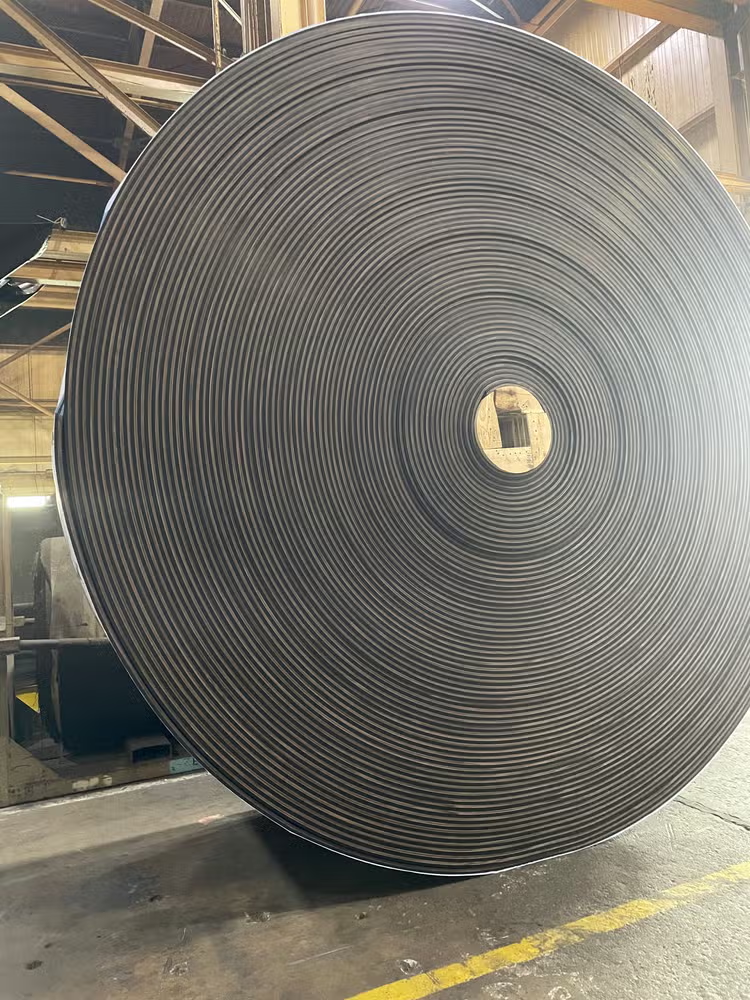
Recovered Carbon Black is now being implemented in several general‑purpose conveyor belt cover compounds. Extensive production trials have confirmed that these compounds maintain equivalent material cost, consistent processing behavior, and reliable performance.
In other words, sustainability gains are being achieved without trade‑offs—a critical requirement for industrial customers who depend on conveyor belt reliability in demanding applications.
Even during testing and ramp‑up, we incorporated approximately 157,000 lbs. of rCB. As production scales, we expect this to become a significant and growing contributor to our sustainability ambitions.
Why This Matters for Business
This initiative highlights an important truth about modern sustainability efforts: progress does not have to come at the expense of performance or profitability.
By integrating recovered carbon black, we’re reducing dependence on oil‑based virgin carbon black production and demonstrating that environmental impact can be reduced today, not just promised for the future. In addition, circular economy principles can be applied in heavy‑duty, industrial applications, and cost discipline and sustainability can advance together.
For customers, this means access to products that perform as expected while supporting your own sustainability objectives. For Continental, it reinforces our long‑term commitment to responsible material innovation and measurable environmental improvement.